


Sunday June 7, 2026
Place your advertisement here.
Contact us today +2207336467/5035263
.
GCRPS Logo
Place your advertisement here.
Contact us today +2207336467/5035263
GRA Image
Place your advertisement here.
Contact us today +2207336467/5035263

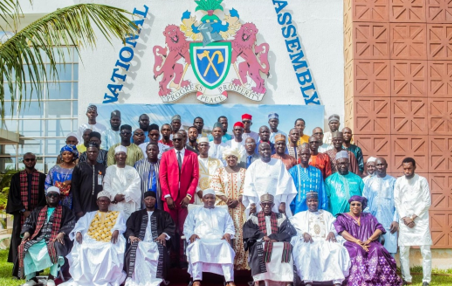
National Assembly of The Gambia: History in Brief

Explore the evolution of The Gambia’s National Assembly from its colonial origins to its current structure under the 1997 Constitution, highlighting legislative milestones, female representation, and democratic transitions.

Share the news with your Friends and Family
History-of-the-National-Assembly-in-The-Gambia

Redaction ARPS Media with National Assembly (assembly.gm)

Establishment: The National Assembly is The Gambia’s unicameral legislature, founded under the 1997 Constitution. It comprises 58 members (53 elected and five presidential appointees) serving five-year terms.

Historical Background: Representative politics began in the 1840s with the Legislative Council. The first Gambian member, Edward Francis Small, joined in the 1880s, and the first elections occurred in 1947. The National Assembly was officially named in 1997.

Contemporary Developments: Universal suffrage for legislative elections was introduced in 1962. The People’s Progressive Party (PPP) dominated until a military coup in 1994. A new constitution in 1996 led to elections in 1997, where the APRC party won the majority.

The Office of the Speaker was Established in 1954, with Sir John Mahoney as the first Speaker. The Speaker is nonpartisan, as outlined in the 1962 and 1997 Constitutions.

Female Representation: Lucretia Claire Jones became the first female appointed to Parliament in 1962, and Nyimasatta Sanneh Bojang was the first female elected in 1982. Female participation has been significant throughout parliamentary history since the mid-1800s.

Original Article at: History – National Assembly

Sign up to receive the latest news and events in your inbox

Join our community of news enthusiasts.

Breaking News in your inbox

Sign up to receive latest news and events in your inbox.

Share the news with your Friends and Family

Related News

Pragmatism over principle: What drives the post-2018 Ethiopia–Somaliland relations?

By Abebe Tigire Jalu The Horn of Africa has long been a place of contradictions: a geostrategic crossroads of global trade and a turbulent panorama of internal strife. Every year, up to 40,000 ships travel through the Red Sea corridor, transporting 40% of the world’s oil supply and approximately $700 billion in commodities. This crucial

Share the news with your Friends and Family

Building Peace With The New Generation

Despite the divisions, war narratives and burdens of the 1990s, young people in the region are finding ways to build bridges and create common spaces to build a better society. This was a conclusion drawn at the international conference “Dayton Legacies: 30 Years of Peace,” held in early December 2025 in Vitez. At the panel

Share the news with your Friends and Family
ARPS Media
ARPS Media

FREE
VIEW