


%20no-repeat%20center%20center;-webkit-background-size:cover;-moz-background-size:cover;-o-background-size:cover;background-size:%20cover;)
At times this year, it has been difficult to pin down where the Trump administration stands on the war in Ukraine. Under Joe Biden, America’s position was clear: the Russian invasion was illegal and the US and its allies would do everything in their power – short of actually taking up arms – to bring the conflict to an end and secure a just and lasting peace for Ukraine.
This involved hundreds of billions of dollars in military and other aid and unrelenting diplomatic pressure. This was clearly not enough, and with Russia regularly issuing bloodcurdling nuclear threats, Biden and his advisers baulked at supplying Kyiv with the weapons that might have helped swing the conflict in Ukraine’s favour.
Since Donald Trump was sworn in for a second term, however, his administration’s mercurial approach to diplomacy has kept everyone guessing. The president’s position has oscillated between contempt for the Ukrainian president, Volodymyr Zelensky, and warmth towards the Russian president, Vladimir Putin, to anger at Putin and affection towards Zelensky.
It would be wrong to say that the US president hasn’t poured energy into securing some kind of deal with Russia. An article in the New York Times this week counted eight phone calls with Putin, five meetings between his envoy Steve Witkoff and the Russian leader and an in-person summit in Alaska.
But when news of a new peace plan emerged last week, it appeared as if the US had become, for all intents and purposes, the Kremlin’s interlocutor. Developed in Miami by Witkoff and Russian businessman Kirill Dmitriev, head of Russia’s sovereign wealth fund, the plan called for international recognition of Crimea and all land occupied by the Russians – by force – since 2014 as being henceforth sovereign Russian territory. Ukraine would also have to cede the remainder of the Donetsk and Luhansk oblasts, where fighting continues. Kyiv would have to accept restrictions on the size of its army and the door to Nato membership would be closed.
Help knowledgeable voices rise above the noise
Support our public service
It reads like Putin’s original wishlist and is neither just nor fair, writes Selbi Durdiyeva, an expert in transitional justice at Nottingham Trent University. Nor does the deal pass muster legally. Durdiyeva walks us through the main objections. She also points out that research has shown that peace agreements imposed over the top of one party’s objections and interests and with no mechanism for accountability, more often than not fail to last.
Read more: Any peace deal in Ukraine must be just and fair – the plan proposed by the US and Russia was neither
Once details of the deal were revealed, European leaders scurried to come up with a response. A revised and slimmed down plan was developed, which deferred some of the key points – including decisions on territory or Ukraine’s Nato membership – to a later date to be discussed between Zelensky and Trump. It also beefed up the language around security guarantees. This is the mechanism by which a peace deal would ensure that Russia cannot simply regroup and attack Ukraine again.

But while security guarantees are vital, Zelensky and his aides will be only too well aware of how flimsy they can be without real teeth. Ukrainians remember the Budapest Memorandum signed by Russia, the US and the UK in 1994, when Ukraine agreed to give up its nuclear arsenal – the third largest on the planet – in return for an agreement by all parties to henceforth respect Ukrainian sovereignty and the country’s internationally recognised borders.
At the risk of stating the obvious, that didn’t work out well for Ukraine. But as Jennifer Mathers points out, the agreement struck in Budapest was hardly robust when it came to guaranteeing Ukrainian security. It pledged, if Ukraine were to be attacked or threatened “with a nuclear weapon”, that the signatories would refer the situation to the UN security council.
Mathers, whose research in international relations at the University of Aberystwyth has a strong focus on modern Russian history, reports that the then president of Ukraine, Leonid Kuchma, remarked after the deal was done (prophetically as it turns out): “If tomorrow Russia goes into Crimea, no one will raise an eyebrow.”
Read more: Ukraine peace deal will hinge on security guarantees – but Kyiv has been there before
Meanwhile, the killing continues. The Washington-based military thinktank, the Institute for the Study of War, says that while the progress on the battlefield remains extremely slow (it estimates that at the current rate, Russia could take until August 2027 to occupy the whole of the contested Donetsk region), the long-range strikes campaign against Ukraine’s cities is taking an increasingly heavy civilian toll.
Much of the killing, on both battlefield and in Ukraine’s cities, is being done by drones, which are estimated to be responsible for 60 to 70% of military deaths and thousands of civilians, in contravention of international law, according to the UN.
But, as Matthew Powell notes, just as drones have transformed the way this conflict has been waged, so technology is already being developed, which, it is hoped, will counter the devastating effect of unmanned aerial vehicles. This is a story as old as warfare itself. As soon as a new class of weapon has proved successful in battle, scientists and engineers find a way to thwart it.
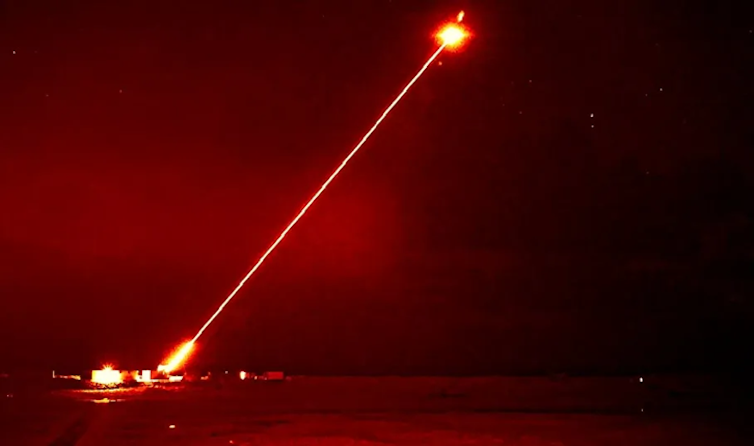
Powell describes two weapons being developed by the British army and navy, which could be deployed relatively soon and which, it is hoped, will go a long way towards countering the threat posed by drones. Both are what’s known as “direct- energy weapons”. One, DragonFire, fires a laser capable of finding and shooting down targets from a distance of one metre. It can lock in on an object as small as a one-pound coin.
The other uses a pulse of directed radio waves to disable a drone’s internal electronics. It has the advantage of not having to lock on to one target (handy when there is cloud cover or fog) and can potentially be used to knock out several targets at once (handy when facing a swarm of drones).
Read more: Drones have changed warfare. Two new weapons might be about alter its course again
Cry the beloved country
For two years, Sudan has been riven by a horrific civil war. Sudan’s army and the powerful paramilitary group, the Rapid Support Forces (RSF), have struggled for control of the central African country. Reports of massacres have become distressingly common, including of thousands killed when El Fasher, the capital of the western Darfur region, was captured after a lengthy siege.
An international group of researchers travelled to Sudan’s southern border, where they interviewed nearly 700 people who were trying to cross into South Sudan. Many of them had already crossed the same border, fleeing the civil war in South Sudan – now they were trying to get to a precarious safety there.
Many of the most harrowing stories were of the sexual violence experienced by women. And the horrifying finding by the research team was that it was adolescent girls who were most at risk. The Conversation’s Insights team worked with the researchers to compile this report, which will shock and upset in equal measure.
Source: Open Newswire @ Ukraine: deal or no deal?