


Thursday April 23, 2026
Place your advertisement here.
Contact us today +2207336467/5035263
.
GCRPS Logo
Place your advertisement here.
Contact us today +2207336467/5035263
GRA Image
Place your advertisement here.
Contact us today +2207336467/5035263

Leveraging Trade to Reduce Plastic Pollution – August 2025 Global Trade Update

Discover how plastic pollution, with 436M metric tons produced in 2023, impacts global health and ecosystems, and why the Global Plastics Treaty aims to address tariff disparities and promote sustainable alternatives to curb this crisis.

Share the news with your Friends and Family
Global-Plastics-Treaty

By Redaction ARPS with UNCTAD

Plastic Pollution Crisis: Plastic pollution affects global health, ecosystems, and development, particularly in developing countries.

Economic Impact: In 2023, global plastic production reached 436 million metric tons, with 75% becoming waste, polluting the environment.

Tariff Disparities: Tariffs on fossil fuel-derived plastics have decreased significantly, while tariffs on natural alternatives remain higher, hindering sustainable investment.

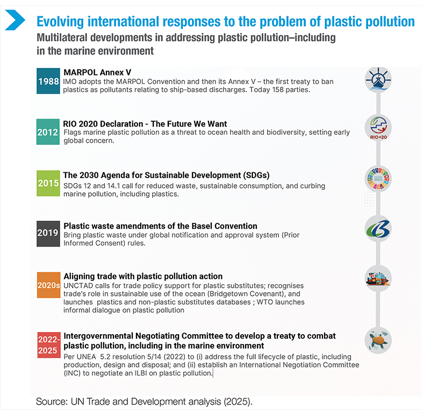
Lack of Global Policy: There is no comprehensive international treaty on plastic, although negotiations are ongoing.

Non-Tariff Measures (NTMs): Countries are implementing various regulatory measures, increasing compliance costs for small businesses and low-income exporters.

Growth of Alternatives: The market for plastic substitutes reached $485 billion in 2023, with a 5.6% growth rate in developing countries, but was hindered by high tariffs and limited incentives.

Call for Action: The upcoming Global Plastics Treaty has the potential to help align trade with sustainability through tariff reforms and enhanced waste management policies.

Read full article at: Global Trade Update (August 2025): Mobilising trade to curb plastic pollution | UN Trade and Development (UNCTAD)

Sign up to receive the latest news and events in your inbox

Join our community of news enthusiasts.

Breaking News in your inbox

Sign up to receive latest news and events in your inbox.

Share the news with your Friends and Family

Related News

Obesity: The chronic disease that isn’t treated like one

A study about weight-loss medications that was published in the British Medical Journal found that less than two years after stopping medications like Ozempic, the weight came back. All health benefits the drugs provide — lower blood pressure, improved cholesterol levels, reduced risk of type 2 diabetes and heart disease — disappeared even faster, returning to pre-treatment levels in just 1.4 years.
While the researchers were surprised how quickly the weight returned, some experts say the drugs are acting just as they would expect — a chronic disease needs chronic treatment.
Even though one in three adult South Africans live with obesity, which is associated with dozens of noncommunicable diseases (NCDs), such as type 2 diabetes, high blood pressure, kidney disease and some types of cancer, it’s still not classified as one in South Africa.
For Bhekisisa’s TV show, Health Beat, we talked to Nomathemba Chandiwana, chief scientific officer of the Desmond Tutu Health Foundation, on why we should.

Share the news with your Friends and Family

Radio Fresh: A Syrian history

By Jo Meg Kennedy Raed Fares and Hamoud Junaid, together with a young colleague, Ali Dandoush, had just left the offices of Radio Fresh, getting into the car together. The director was at the wheel and, shortly after, noticed a silver van behind them. He took a dirt road to get away, but everything had already

Share the news with your Friends and Family
ARPS Media
ARPS Media

FREE
VIEW