

%20no-repeat%20center%20center;-webkit-background-size:cover;-moz-background-size:cover;-o-background-size:cover;background-size:%20cover;)
Economic development has been a cornerstone of Cambodian Prime Minister Hun Manet’s administration since he succeeded his father Hun Sen in 2023. Adhering to his father’s playbook, tenets of democracy like the rule of law have taken a backseat in the drive towards economic growth. But Hun Manet’s strategy of stoking Khmer nationalism while pursuing a developmentalist agenda appears to be yielding mixed results.
The Hun Manet government has sought to keep the ‘runways’ of development moving while managing the ‘redlines’ of Khmer nationalism, stoked during the 2025 Thai–Cambodia border conflict. This begs the question of what Hun Manet’s regime stands to gain and lose in balancing nationalism with a developmentalist agenda.
Hun Manet’s government fits the model of authoritarian developmentalism, in which leaders curtail democratic principles like press and academic freedoms while pursuing economic development as thesolution to society’s ills. Economic growth is placed on a pedestal, meaning that its failed delivery may seriously undermine regime legitimacy.
Many of these hallmarks can be observed in Cambodia. Phase one of the Pentagonal Strategy maps the government’s ambitions for Cambodia to reach upper-middle income status by 2030 and high-income status by 2050. But political repression, violence and lawfare continue to dog domestic politics.
Pursuing an authoritarian developmentalist strategy is useful to Hun Manet. The ongoing succession from father to son is part of a broader generational shift from the old guard — embodied by figures like Hun Sen, Sar Kheng and Tea Banh — to a new, albeit familial generation. Lacking his father’s background as a resistance fighter against the brutal Khmer Rouge, Hun Manet and his peers are seeking their own sources of political legitimacy.
Hun Manet’s plans for Cambodia’s modernisation and economic development are far-reaching. The government has moved to boost and diversify foreign direct investment and is committed to modernising and strengthening the agricultural sector. Major infrastructure projects are sharpening Cambodia’s competitive edge, like the port expansion in Sihanoukville and the construction of the Funan Techo Canal.
The tourism industry has also seen considerable investment. The new Siem Reap-Angkor International Airport was officially opened in 2023, followed by Techo International Airport in 2025. These infrastructure projects perform a dual purpose of developing the economy and projecting the administration’s domestic legitimacy.
But cracks are visible in the developmentalist facade. The slowdown in the Chinese economy — a major source of investment for Cambodia — has had serious knock-on effects, while the lack of funding transparency around the Techo Canal has raised questions. Downturns in construction and real estate prove growth is anything but steady. And the rise of cyber scams has damaged Cambodia’s reputation and triggered international sanctions.
The escalation of Thai–Cambodia border skirmishes to violent clashes in July 2025 ruptured peace — which, along with political stability, is seen by Hun Manet as essential to economic development.
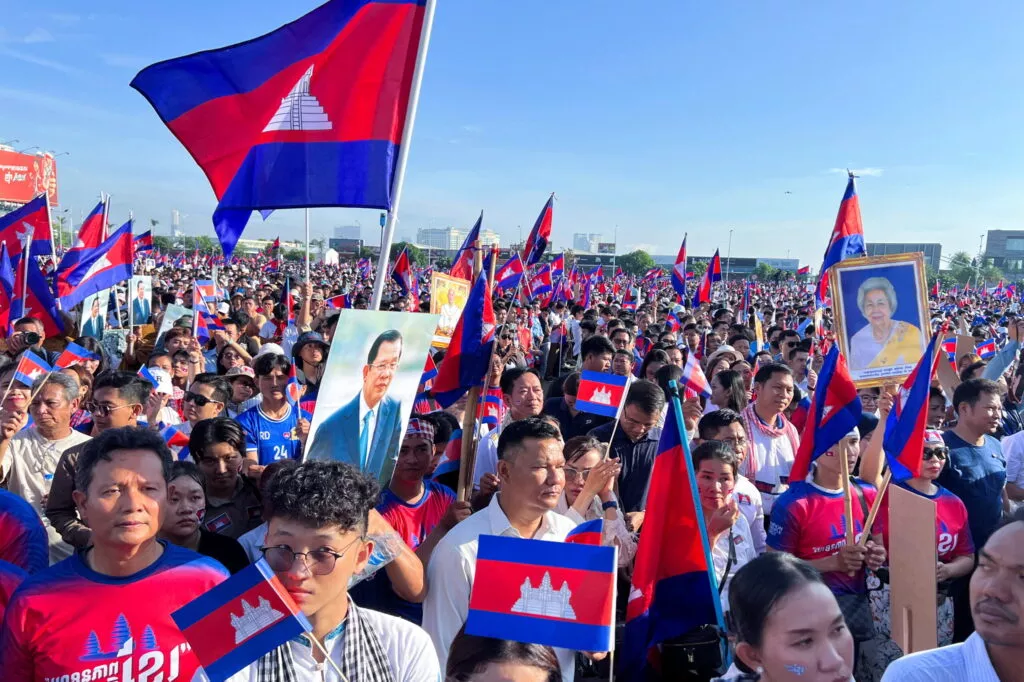
Still, the dispute became a fulcrum to promote national unity, with Hun Sen playing a prominent role in stoking nationalist posturing and bans enacted on Thai film, TV and fruit and vegetable imports. More than 100,000 people joined the Solidarity March led by Deputy Prime Minister Hun Many, while Hun Manet asserted a territorial ‘redline’ to ward off Thai encroachments. This positioned the government as the defender of Cambodia’s national interest against external aggression.
But the conflict’s protracted nature had detrimental effects. The Asian Development Bank cut Cambodia’s 2025 growth forecast from 6.1 to 4.9 per cent and the 2026 forecast from 6.2 to 5 per cent due to border tensions and uncertainty in the US export market. Additional pressures for social spending to support displaced populations are also likely. Yet expectations for economic growth remain steady, supported by the country’s industrial base and FDI.
The case of tourism also highlights the risk of conflict to the government’s developmentalist agenda. For instance, the Asian Tour’s LIV Golf-backed International Series Cambodia was cancelled due to political tensions between Thailand and Cambodia.
International tourist numbers also took a hit. The Ministry of Tourism’s August 2025 Statistics Report indicates that international tourist arrivals were up 4.4 per cent in May compared to 2024. After hostilities began, monthly international arrivals dropped roughly 20–40 per cent. Visitors from Thailand were down 28.2 per cent since 2024, though those from China increased by 45.7 per cent. While Cambodia should focus on diversifying sources of international tourism to counteract the loss of visitors from Thailand, lasting gains will only come from restoring a stable, conflict-free environment.
The Cambodian case illustrates that unsteady economic growth and nationalistic brinkmanship are not well-suited bedfellows. While the mobilisation of nationalist sentiment may have produced a short-term boon in government popularity, sustained conflict runs counter to assurances of peace, stability and economic development. Successfully building and profiting from the runways of development requires the careful management of nationalistic redlines.
Scott Rawlinson is Visiting Research Fellow at the University of East Anglia.
Source: Open Newswire @ Stoking nationalism costs Cambodia economic growth | East Asia Forum