


%20no-repeat%20center%20center;-webkit-background-size:cover;-moz-background-size:cover;-o-background-size:cover;background-size:%20cover;)
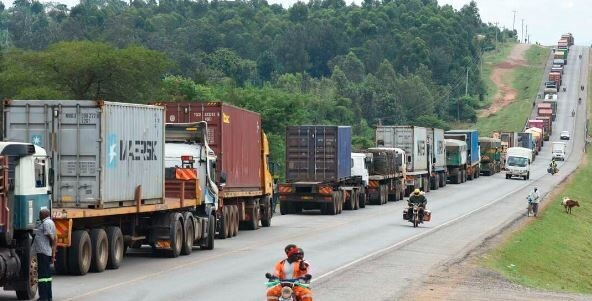
A senior management team from the South Sudan Revenue Authority (SSRA) and the top management of the Uganda Revenue Authority (URA) have operationalized the South Sudan Electronic Cargo Tracking System and rolled out the usage of the E-permit system.
The two countries also agreed to jointly enforce the new digital permits across their borders.
Early this year, South Sudan unveiled an electronic permit system covering all incoming goods. Although some sections of the business community pushed back, officials maintain the reform is essential for curbing smuggling, cargo diversion, and revenue loss.
The move, officials say, is meant to stop the long-standing problem of smuggling, cargo diversion, and revenue losses.
According to tax officials, the introduction of the E-permit system is set to streamline the process of importing goods into South Sudan from the EAC region, e.g, Kenya or Uganda, by requiring the payment of taxes on the goods before they are released from the point of loading to minimize delays and reduce the risk of revenue leakage. This new policy targets high-risk items, namely, cigarettes, Alcohol, electronics, hookah tobacco (shisha), motor vehicles, and cosmetics.
On 20 November, William Anyuon Kuol, the SSRA Commissioner General, directed all customs officers, importers, transporters, and clearing agents to fully comply with the digital system.
His directive followed an earlier communication between the SSRA and URA that emphasized that no goods would be allowed into South Sudan without an approved e-permit.
“Any trader who changes the final destination of goods from DR Congo to South Sudan must also follow the e-permit procedures and get fresh approval,” Kuol stressed. “This directive takes immediate effect, and failure to comply will lead to delays, penalties, or non-clearance of goods at the border.”
The e-permit system is part of a wider digital cargo monitoring initiative that South Sudan launched this year. It works hand-in-hand with the Electronic Cargo Tracking System (ECTS), which uses tamper-proof seals to track trucks from departure to their destination. This seeks to stop trucks from diverting goods meant for South Sudan back into Uganda or somewhere, where they are smuggled onto the local market without taxes.
Diing Majur, an Assistant Commissioner at SSRA, said the reform is long overdue.
“For many years, South Sudan has lost revenue because of weak border controls and manual paper systems,” Majur stated. “The e-permit finally gives us real-time information and helps us stop people who take advantage of the old loopholes.”
She added that the system aligns South Sudan with regional standards already used in Kenya, Uganda, Rwanda, Tanzania, and Ghana, countries that report huge gains in revenue and reduced smuggling.
Meanwhile, Godson Mwesigye, URA’s Commissioner for Enforcement, told Uganda Radio Network (URN) during an interview that the new system has already helped reduce contraband entering Uganda.
“We used to destroy illegal cigarettes worth about 10 billion shillings every year,” he said. “But since the digital tracking system started in March, smuggling has dropped sharply, especially in northern Uganda.”
He said petroleum products, which were often diverted and sold illegally, are now moving more transparently. URA enforcement teams have recovered tens of thousands of liters of fuel in recent months.
According to Mwesigye, some traders, clearing agents, and truck drivers complained that they were not sensitized early enough, while others struggled with the new procedures, causing delays in the first weeks.
“But the biggest challenge is not from genuine traders,” he explained. “It is from people who benefited from the old smuggling networks. They are fighting the system because they have lost their loopholes.”
Mwesigye said some groups have gone as far as running online smear campaigns to discredit the system. One false claim even alleged that he was linked to political changes in South Sudan.
“I have never been to Juba,” he said. “I am a Ugandan doing my job. It is shocking to see my name dragged into South Sudan politics just because we are enforcing a system that improves transparency.”
Information from SSRA indicates that through the e-permit system, South Sudan has processed 2,730 consignments worth about USD 17 million since March, and another 14,763 consignments, valued at USD 92 million, moved outside the system, showing the scale of the problem the new reforms are trying to solve.
Majur said this gap is exactly why the enforcement must be tightened. “The fact that we can now identify these discrepancies is a major achievement. Before digitalization, we had no reliable data.”
Authorities from both countries agree that once fully implemented, the system will reduce illegal goods entering Uganda, protect genuine traders from unfair competition, give South Sudan accurate data for planning and taxation, reduce delays at the border, and strengthen this trade corridor. South Sudan takes nearly 80% of Uganda’s formal regional exports with food, cement, fuel, beverages, and household goods crossing the border every day.
“The system is here to stay,” Majur said. “Those who oppose it may shout now, but they will not stop the progress. Digital systems are the future of trade.”
Source: Open News Wire @ South Sudan, Uganda launch electronic tracking of goods to check smuggling – Radio Tamazuj