


%20no-repeat%20center%20center;-webkit-background-size:cover;-moz-background-size:cover;-o-background-size:cover;background-size:%20cover;)
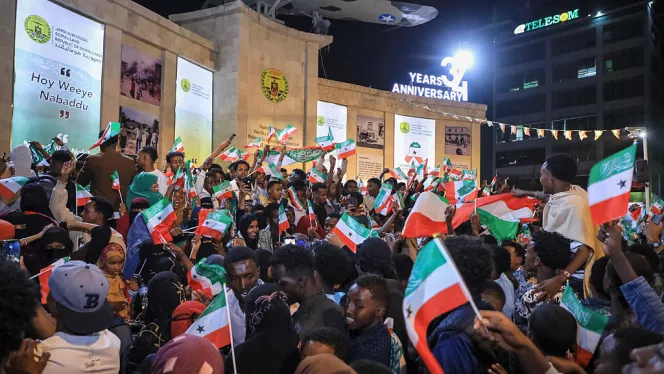
Somalia’s Defense Minister Ahmed Moalim Fiqi has escalated his government’s rhetoric over the growing rapprochement between Israel and Somaliland, claiming that Mogadishu possesses confirmed information about an Israeli plan to relocate Palestinians from the Gaza Strip to Somaliland. The minister, however, provided no public evidence or documentation to support the allegation, while authorities in Hargeisa have repeatedly denied the existence of any such agreement.
Fiqi made the remarks in an interview with Al Jazeera, describing the alleged plan as a serious violation of international law and urging Israeli Prime Minister Benjamin Netanyahu to reverse Israel’s decision to recognize Somaliland. He argued that Israeli recognition constitutes a direct attack on Somalia’s sovereignty. Observers note, however, that raising the Gaza issue in this manner appears to be part of broader diplomatic efforts by Mogadishu to rally regional and international opposition to Somaliland’s recognition, particularly after Israel became the first country to formally recognize it in late December 2025.
In Hargeisa, the response was more direct. In early January, Somaliland’s Ministry of Foreign Affairs described claims about resettling Palestinians or establishing Israeli military facilities as “baseless,” stressing that engagement with Israel is “purely diplomatic” and conducted with “full respect for international law.”
Al Jazeera also quoted Israeli Foreign Minister Gideon Sa’ar as telling an Israeli television channel that the “forced transfer” of Palestinians to Somaliland “is not part of our agreement.” Neither side has disclosed detailed information about the understandings that followed Israel’s recognition. According to The Times of Israel, officials in Somaliland and Sa’ar both emphasized that the diplomatic agreement did not include any provision for resettling Gaza’s population, despite ongoing debate in Israel over “voluntary migration” proposals raised by some officials in the context of the Gaza war.
Nevertheless, security-related concerns have not been entirely dismissed. While Somalia’s defense minister accused Israel of seeking to establish a military base near the Bab al-Mandeb Strait to “destabilize the region,” reports point to growing security discussions. The Times of Israel cited Israel’s Channel 12 as quoting Deqa Qassim, Director of the Political Department at Somaliland’s Foreign Ministry, as saying that the idea of an Israeli military base is “being considered and discussed,” and would depend on the terms of any future agreement following the opening of mutual embassies. She reiterated that the resettlement of Gaza’s Palestinians was not part of the recognition or the initial understandings.
These exchanges come amid a new political reality shaped by Saar’s visit to Hargeisa on January 6. During the visit, Sa’ar met Somaliland President Abdirahman Mohamed Abdullahi (Irro), and the two sides discussed expanding cooperation in areas such as agriculture, health, technology, and the economy. An official Israeli invitation was also conveyed to the president to visit Israel, an initiative Hargeisa views as an opportunity to advance development and investment goals and to break its international isolation.
Mogadishu, meanwhile, has emphasized the sovereignty dimension. Somalia’s Ministry of Foreign Affairs said that any formal engagement with Somaliland without the consent of the federal government is “illegal and null and void,” calling on the United Nations and the African Union to support Somalia’s “territorial integrity.” The African Union’s Peace and Security Council likewise called for the “immediate revocation” of Israel’s recognition of Somaliland, reflecting the scale of pressure Mogadishu is seeking to mobilize within continental institutions.
On a parallel track, the Organization of Islamic Cooperation has seen institutional escalation. OIC held an extraordinary session in Jeddah on Saturday, January 10, 2026, at Somalia’s request, adopting a resolution condemning Israel’s recognition of Somaliland as a threat to peace and stability, alongside a second resolution on Palestine rejecting forced displacement plans. This reflects Mogadishu’s attempt to link the Somaliland issue with Gaza in order to secure broader backing across the Islamic world.
International support for Mogadishu’s position has also emerged. Reuters reported that Chinese Foreign Minister Wang Yi told his Somali counterpart that Beijing supports Somalia’s unity and territorial integrity, while explicitly criticizing Somaliland’s ties with Taiwan. Al Jazeera reported that India likewise reaffirmed its commitment to the principle of Somali sovereignty and territorial unity.
Yet comparisons on the ground remain central to Hargeisa’s narrative. In a previous report, Reuters noted that Somaliland has “remained largely peaceful” since declaring independence in 1991, while Somalia has faced a long-running armed insurgency. Somaliland officials cite this contrast to justify their pursuit of international recognition, insisting that their foreign relations, including with Israel, are not a “bargain over Gaza,” but part of a broader quest for international legitimacy and development partnerships.
Source: Newswire @ Somalia escalates rhetoric over Israel–Somaliland deal | Geeska