


%20no-repeat%20center%20center;-webkit-background-size:cover;-moz-background-size:cover;-o-background-size:cover;background-size:%20cover;)
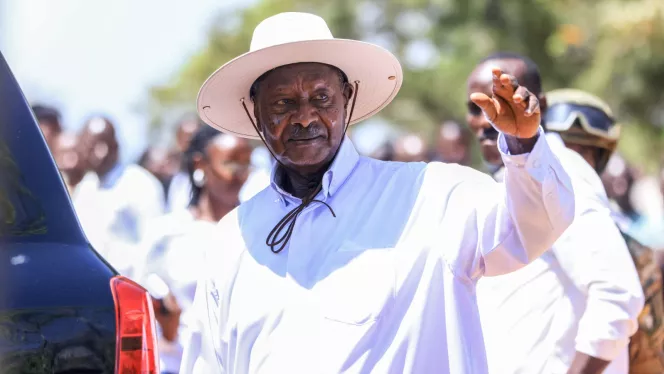
Uganda’s 2026 presidential election has been declared in favor of incumbent President Yoweri Museveni, who secured 71.65 percent of the vote, according to results announced by the Electoral Commission. His closest challenger, opposition leader Robert Kyagulanyi Ssentamu, popularly known as Bobi Wine, finished second with 24.72 percent.
The election was held on 15 January 2026, with final results announced between 17 and 18 January at the National Tally Centre in Lubowa. Official figures show that Museveni received 7,946,772 votes, while Kyagulanyi garnered 2,741,238. Voter turnout stood at 52.5 percent out of approximately 21.6 million registered voters. Other candidates trailed far behind with marginal vote shares.
International reaction followed swiftly. The Chairperson of the African Union Commission, Mohamed Yousuf, congratulated Museveni on his victory, praising the “conduct of the elections in Uganda.” He said the African Union would continue to “support democratic governance across the continent” and commended Ugandans for their “commitment to peace, security, and development.”
However, the results were immediately rejected by Kyagulanyi, who called on Ugandans to denounce what he described as a fraudulent outcome. In a video posted on his social media platforms, the opposition leader claimed he had been placed under house arrest and that his residence was attacked on the eve of the election. He said he narrowly escaped and is currently in hiding.
Museveni’s victory extends his rule to a seventh term in office, having first come to power in 1986. His long tenure has been marked by relative security and periods of economic growth, but also by sustained criticism from opposition groups and rights organizations over alleged human rights abuses, abductions, and restrictions on political space.
Bobi Wine’s National Unity Platform has further consolidated its position as the country’s main opposition force, though it remains unable to unseat the ruling National Resistance Movement. Parliamentary elections were held alongside the presidential vote, with all 529 seats contested. The NRM retained a majority, reinforcing Museveni’s control over both the executive and legislative branches.
As Uganda enters another five-year term under Museveni’s leadership, questions remain over political succession, democratic reform, and stability. With the opposition disputing the results, regional and international observers are expected to closely monitor developments in the post-election period.
Source: Museveni extends 40-Year rule in Uganda Election | Geeska