
%20no-repeat%20center%20center;-webkit-background-size:cover;-moz-background-size:cover;-o-background-size:cover;background-size:%20cover;)
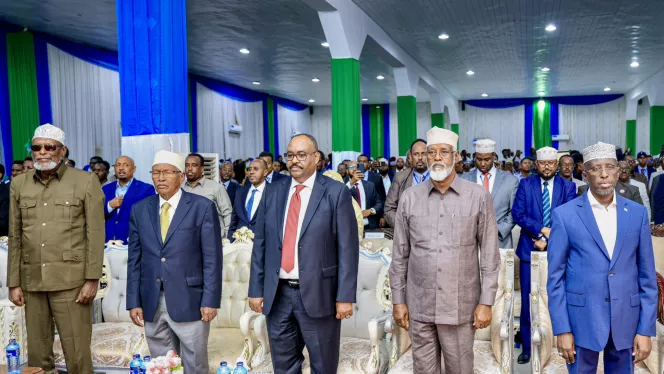
Somalia’s most influential opposition gathering in recent years concluded on Saturday in the port city of Kismayo, with senior political leaders issuing a sweeping communiqué that criticizes the federal government and outlines a coordinated opposition roadmap.
The meeting brought together key opposition figures under the umbrella of the Somali Future Council, including former President Sheikh Sharif Sheikh Ahmed, Puntland President Said Abdullahi Deni, Jubbaland President Ahmed Islam Ahmed (widely known as Madobe), members of both chambers of the Federal Parliament, former senior government officials, and representatives of civil society.
While opposition consultations have taken place intermittently since the beginning of the year, observers described the Kismayo conference as the most influential and consequential opposition convergence to date, both in terms of its breadth of representation and the scope of its resolutions.
Held from 18 to 20 December 2025, the gathering styled itself as a National Consultative Congress aimed at assessing Somalia’s overall political and security trajectory. According to the final communiqué, deliberations focused on four interlinked crises: political governance, national security, economic decline, and humanitarian distress.
At the core of the communiqué is a sweeping indictment of President Hassan Sheikh Mohamud’s administration, which the opposition accuses of systemic failure across all four fronts.
On governance, the Somali Future Council accuses the president of unilaterally altering the 2012 Provisional Constitution, undermining what it describes as the social contract underpinning Somalia’s federal system. The communiqué alleges that the executive branch has captured constitutional institutions meant to check presidential power, thereby “eroding institutional balance and democratic accountability.”
The statement links these accusations to a two-year-long constitutional amendment process that plunged the country into a deep political crisis. President Mohamud’s administration introduced several controversial amendments, including changes to the role of the prime minister and proposals that would have extended presidential terms. Some of these changes were later partially reversed following negotiations with a group of opposition figures led by former Prime Minister Omer Abdirashid Ali Sharmarke, though the opposition argues that the underlying crisis remains unresolved.
A particularly sensitive issue highlighted in the communiqué is the federal government’s alleged tolerance, and tacit endorsement, of term extensions in some Federal Member States. The opposition describes this practice as “deeply destabilizing within Somalia’s post-transition political order.”
On security, the communiqué delivers one of its strongest rebukes. The opposition accuses the federal government of abandoning the fight against Al-Shabaab, claiming that military operations have stalled and that national forces have been left exposed to militant advances.
According to the statement, “corruption, favoritism, and abuse of power” within the security sector have destroyed morale, discipline, and the operational doctrine of the Somali National Army. These failures, the opposition claimed, have directly contributed to deteriorating security conditions and the resurgence of extremist threats, including both Al-Shabaab and ISIS-affiliated groups.
The communiqué further links governance and security failures to what it describes as a worsening economic and humanitarian emergency. The opposition accuses the federal administration of presiding over widespread corruption, including the illegal sale of public land, and of failing to mitigate the social and economic fallout of prolonged instability.
On elections, the Somali Future Council categorically rejected any form of term extension at the federal level, warning that such a move would trigger “political instability, constitutional collapse, and renewed insecurity.”
Despite its criticism, the communiqué leaves the door open for dialogue. The opposition expressed readiness to engage President Hassan Sheikh Mohamud in negotiations to organize a consensus-based, transparent, and timely election, explicitly calling for a process that improves upon the 2022 electoral model.
Since the end of Somalia’s transitional period, elections have been conducted through an indirect system involving clan delegates, a model that has defined Somali politics for more than a decade. President Mohamud’s administration has aggressively promoted a shift to a “one person, one vote” system. The opposition, however, argues that the current push lacks legitimacy, institutional readiness, and broad political consensus. The communiqué called on the president to convene all political stakeholders by 20 January 2026 to reach agreement on an electoral framework that meets these conditions.
Anticipating the possibility that the president may ignore their call, the opposition warned that it is prepared to take the initiative to “organize an alternative electoral process” to prevent what it described as a looming “constitutional vacuum.” While the statement does not specify how such a process would be implemented, the language signals a readiness for confrontation if talks fail.
The opposition also rejected the ongoing electoral process in the Banadir region, describing it as a one-sided exercise driven by a single political group. Proceeding with such elections, the communiqué said, without consensus on the constitutional status of the capital, “violates both the Provisional Constitution and national laws.”
Taken as a whole, the Kismayo meeting reflects a familiar pattern in Somali politics: opposition coalition-building aimed at confronting an incumbent administration. Yet the scale and coherence of this gathering suggest a higher level of coordination than in previous efforts. While the federal government has yet to issue a formal response, the conference underlines that Somalia is entering a high-stakes political phase. The positions articulated in Kismayo are likely to shape the trajectory of Somalia’s political contest in the months ahead. President Mohamud, meanwhile, has doubled down on the “one person, one vote” agenda, repeatedly criticizing the opposition for failing to present a viable alternative.
The coming months will be decisive in determining Somalia’s electoral path, and whether political competition can be managed through consensus or slides toward confrontation.
Source: Newswire @ Kismayo declaration puts Somalia on a political knife-edge | Geeska