

By EAF editors: The Australian National University
In September 2026, the United States and Japan will mark the 75th anniversary of the US–Japan alliance. But US President Donald Trump’s shift to a ‘might makes right’ international order means it won’t be an occasion to celebrate.
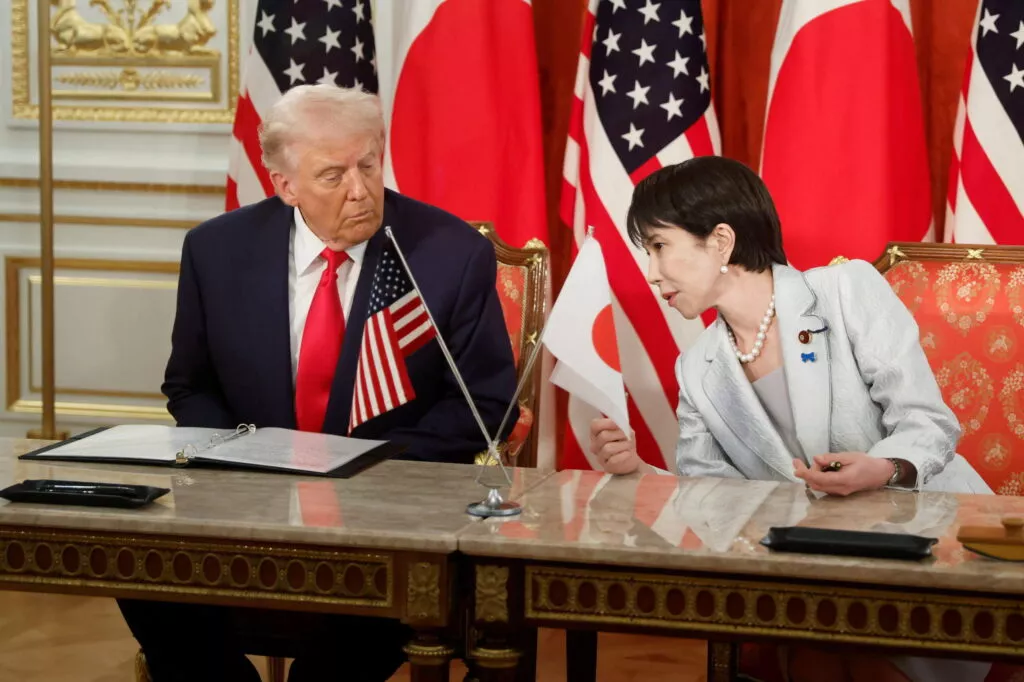
Uncertainty continues to grow over the credibility of US alliance obligations under Trump — and not least in Japan, where Prime Minister Sanae Takaichi seeks her first electoral mandate on 8 February from an electorate increasingly concerned about Japan’s place in a deteriorating global order.
For three quarters of a century, the core bargain of Japan’s alliance relationship with the United States was simple — Japan provided the Americans with territory for military bases, allowing the US to project power in the Pacific. In exchange, the United States guaranteed Japan’s security.
This stability provided by US power enabled Asia to cultivate a regionalism focused on attaining shared peace and prosperity. Japan recovered from its defeat in war to establish regional production networks and become the world’s second largest economy in 1967, only overtaken by China in 2010.
As Asia became richer and US rivalry with China intensified, Washington has increasingly asked its regional allies to assume greater defence burden sharing responsibilities. The United States has at times — including during the ‘Japan bashing’ episodes of the 1980s and ‘chequebook diplomacy’ during the Gulf War — criticised Japan over the asymmetrical nature of the alliance. Washington has pointed to Japan’s long-standing practice of limiting defence spending to 1 per cent of GDP (effectively from 1962 to 2022) and its maintenance of the Article 9 ‘peace clause’ of Japan’s post-war constitution as evidence for this asymmetry.
Yet over the decades, Japan has increased its ability to contribute to its own defence and extended the roles and functions of its Self-Defense Forces within Article 9’s framework. Former prime minister Fumio Kishida’s government planned to raise defence spending to 2 per cent of GDP by the end of 2027, a timeline which Prime Minister Sanae Takaichi has expedited to March 2026.
Despite Japan’s moves to bolster its security posture in recent years, there is still a prevailing view across the defence establishment that it has no choice but to rely on US security — particularly its nuclear guarantee, given its geographical proximity to nuclear capable China, Russia and North Korea.
As Hitoshi Tanaka explains in this week’s lead article, the Trump administration’s so-called Donroe doctrine — under which ‘might makes right’ — has been a great shock not just to Europe and Latin America, but also to US allies in Asia. The abduction of Venezuelan President Nicolas Maduro and threats to take over Greenland by force if necessary have shaken trust in the United States around the world. These actions fundamentally undermine the principles of international law that Japan has relied upon since 1945, directly contradicting ‘a principle frequently invoked by both Washington and its Western allies — that changes to the status quo by force are unacceptable’.
There’s a general resignation in Tokyo that Japan is locked into the US alliance, no matter how much worse policies under Trump become. Coupled with a hawkish turn in Tokyo’s approach to China, Japan risks being stranded in a worst-case scenario — facing a chronically dysfunctional relationship with China and a diminished security guarantee from the United States.
This dilemma is also felt in Australia where, as James Curran writes at East Asia Forum, ‘Canberra’s underlying policy is to keep its head down for the remainder of Trump’s term’, and ‘not get out ahead of other middle powers in calling for bolder movement and try to muddle through’.
Canberra and Tokyo can do better.
It is self-defeating to forego opportunities to shape the emergent regional order out of fear of being seen as too close to China by Washington. Instead, both should coordinate their diplomatic and economic leverage to open space for dialogue and cooperation with Beijing on matters of shared importance — from climate to trade.
Engagement through ASEAN frameworks to deepen regionalism and integration is something we’ve long called for. The CPTPP accession process offers a valuable avenue to open dialogue with China on matters of domestic policy reform that, if unchecked, will remain sources of tension with trading partners.
Japan and Australia have the opportunity to use their influence over the CPTPP accession process as a political fillip to empower the reformists who have struggled amid China’s securitisation of economic policy under Xi. Doing so could draw the Chinese system into deeper engagement with a project too important to jeopardise through confrontational behaviour towards prospective CPTPP partners.
Hawks in Tokyo and Canberra will warn that past experience with Chinese economic coercion shows that deepening economic engagement with Beijing will introduce vulnerabilities for whoever engages in it. But this ignores the reality that withdrawing from economic dialogue ensures the relationship will be defined solely by hard security issues, to absolutely nobody’s benefit.
The EAF Editorial Board is located in the Crawford School of Public Policy, College of Law, Policy and Governance, The Australian National University.
Source: Japan’s muted response to the shock of Trump’s Donroe doctrine | East Asia Forum