


%20no-repeat%20center%20center;-webkit-background-size:cover;-moz-background-size:cover;-o-background-size:cover;background-size:%20cover;)
Judicial Officers Association of South Africa complains of “economic abuse”
By David Capel
Magistrates across South Africa are on the verge of mutiny.
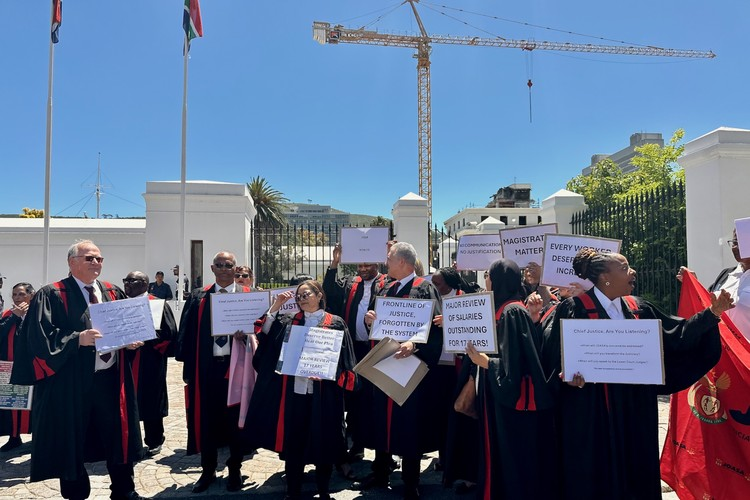
In protests organised and led by the Judicial Officers Association of South Africa (JOASA), magistrates have recently taken to the streets to complain about remuneration and working conditions.
Their discontent is likely to affect witnesses, accused persons, prosecutors and the overall running of criminal courts.
“For the last 17 years, magistrates have been ignored and sidelined,” says JOASA president Neelan Karikan. “This has resulted in magistrates now being financially embarrassed and having to go under debt review, with many getting blacklisted and having civil judgments against them,” he says.
He says JOASA has about 800 paid-up members and is “growing every day”. There are some 2,000 magistrates in South Africa.
“We now also include traditional leadership, who preside in our traditional courts. We also have friends of the association who have joined the organisation. They include attorneys, advocates, prosecutors and anyone who is fit and proper within the legal fraternity”, he says.
Karikan says JOASA’s primary focus is short and simple: “To eliminate the systemic economic abuse that lower court magistrates are experiencing”.
Magistrates, he says, do not get paid in accordance with their experience and expertise.
“A magistrate earns in a month what senior counsel earn in a day. They earn less than much more junior prosecutors,” he says.
“This has left them financially vulnerable, while judges of the High Courts are fully protected in all these aspects. They have no reason to take to the streets.”
“We do 95% of all judicial work in the country and make up 95% of the judiciary”.
After paying off their bonds, cars, insurance, security, medical aid and education fees, magistrates are left with a deficit every month, he says. Many have been in debt review, some have been blacklisted or have had civil judgments against them.
Karikan says JOASA aims to bring “radical judicial transformation” within the parameters of the Constitution. This involves:
- a single judiciary;
- the removal of disparities in magistrates’ remuneration and benefits (including vehicle provision, tax allowances, retirement security, and long service recognition);
- a dedicated pension fund for magistrates;
- a fair and transparent national transfer policy for magistrates;
- the advertisement of magistrate vacancies internally before external recruitment; and
- civil liability protection for magistrates in line with the provisions applicable to judges,
Karikan says that, unlike judges, magistrates are not explicitly protected from civil liability for judicial acts, unless consent is granted by the Chief Justice. This exposes magistrates to undue legal risk and undermines judicial independence, he says.
He says JOASA has approached Parliament, the Presidency, the Minister of Justice, the Public Protector, the Human Rights Commission and others, to no avail. “They all agree with the cause but have not been able to action any changes. We have to force their hand.”
“We need more courts, administrative support, basic tools of trade and adequate security.
“Right now, security for our lower court magistrates is paramount. We are being killed and attacked on a regular basis. Only the High Court seems to get the tools necessary, while we deal with the most serious matters on the ground.
Magistrates should not be forced to go to the streets,” Karikan says.
“Every South African has the right to access courts for the resolution of legal disputes, which is a cornerstone of a fair and democratic society,” Karikan said in a letter to Parliament’s Portfolio Committee on Justice and Constitutional Development. “Magistrates’ Courts are often the first—and, for many, the only—point of entry to the justice system, underscoring the importance of ensuring these courts are equipped to function efficiently and independently.”
David Capel is a freelance journalist. This is the second in a short series on the running of district criminal courts in Cape Town.
Source: Open News wire @ Why magistrates are protesting | GroundUp