


%20no-repeat%20center%20center;-webkit-background-size:cover;-moz-background-size:cover;-o-background-size:cover;background-size:%20cover;)
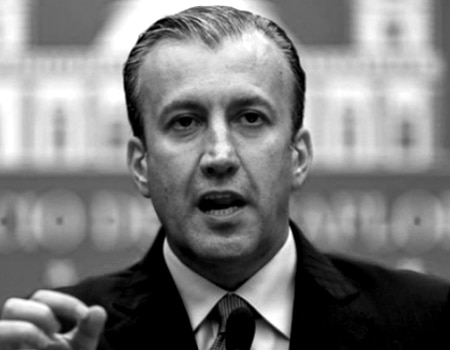
Tareck El Aissami is a high-profile Venezuelan politician who was arrested on corruption charges. Over the course of his political career, he held senior posts in the administrations of Hugo Chávez and Nicolás Maduro, including Executive Vice President of the Republic and Minister of Petroleum — positions from which he laid the groundwork for several illicit schemes that ultimately led to his imprisonment.
In April 2024, 13 months after his resignation and disappearance from the political scene, Venezuelan prosecutors arrested El Aissami alongside businessman and alleged frontman Samark López Bello and former Economy and Finance Minister Simón Zerpa for their alleged involvement in the corruption scheme known as PdVSA-Cripto.
History
El Aissami studied Law and Criminology at the University of Los Andes (ULA) in Mérida state, becoming involved at an early age in leftist student movements.
In 2005, he ran in congressional elections and won a seat in the National Assembly representing Mérida. Two years later, in January 2007, he left that post to take up the Vice Ministry for Crime Prevention and Citizen Security. In September 2008, El Aissami became Minister of Interior and Justice, a position he held until October 2012. Changes introduced to the prison system during his tenure helped fuel the rise of a new criminal power structure inside Venezuelan prisons: the pranato. Under this system, the state handed control of prisons to inmate leaders known as pranes, in exchange for their guaranteeing order and control inside the facilities.
El Aissami loosened prison visitation rules, allowing a greater flow of goods and services into penitentiaries and encouraging the growth of illegal economies behind bars. Pranes — powerful inmates who led criminal factions within prison — began charging fees on everything entering the prisons. Food vendors, barbershops, and small businesses were also taxed, steadily increasing the pranes’ power. Their control over the prisons allowed them to bring family members, sex workers, drugs, and alcohol facilities into the prison with growing ease. Meanwhile, they began to replicate their criminal structures outside the prison walls.
As minister, El Aissami also created the Bolivarian National Police (Policía Nacional Bolivariana – PNB) in 2009, weakening security bodies run by opposition-led municipalities and state governments. From that point on, crime rose sharply in Caracas and other cities.
His alleged ties to organized crime began to surface publicly in 2010, when Venezuelan drug trafficker Walid Makled claimed that a brother of El Aissami facilitated his illegal operations and that the then-minister was not only aware of them but also complied with Makled’s requests.
On December 16, 2012, El Aissami left the Interior Ministry to become governor of Aragua state. Violence surged during his administration, turning Aragua into one of Venezuela’s most insecure states.
Despite mounting accusations, El Aissami’s political ascent continued. On January 4, 2017, Nicolás Maduro appointed him executive vice president, delegating 14 presidential powers to him, including budget oversight and the creation of government entities. Just weeks later, on February 13, the US Treasury Department accused El Aissami of drug trafficking and sanctioned him, canceling his visa, freezing his US-based assets, and banning transactions with US institutions. Maduro responded by keeping him in office until June 2018, when he appointed him minister of the newly created Ministry of Industries and National Production and made him the Vice President of the Economy.
In March 2019, the US government again targeted El Aissami and his alleged frontman López Bello, accusing them of evading the 2017 sanctions by traveling from Russia to Venezuela on private aircraft provided by US-based companies.
In April 2020, El Aissami left the Industries Ministry to become Minister of Petroleum. From that post, he implemented a strategy to circumvent US sanctions on Venezuelan oil sales by relying on intermediaries, further deepening opaque practices within the state oil company.
El Aissami resigned on March 10, 2023, amid a surprise corruption probe into Petróleos de Venezuela (PdVSA) led by Venezuelan prosecutors, which resulted in the arrest of dozens of senior officials and business figures linked to him. He then vanished from public life for more than a year.
On April 9, 2024, Venezuela’s attorney general, Tarek William Saab, announced El Aissami’s arrest, accusing him of leading a scheme that irregularly sold PdVSA crude shipments, with proceeds that never reached state coffers and instead became part of a large-scale money laundering operation.
Criminal Activities
A statement by the Office of Foreign Assets Control (OFAC) asserts that the former vice president “facilitated, coordinated, and protected” drug trafficking in Venezuela. Specifically, OFAC states that he provided protection to drug traffickers and oversaw or partially transported more than one metric ton of narcotics bound for Mexico and the United States.
According to Venezuela’s attorney general, Tarek William Saab, the former minister also leveraged his positions, influence, and allied senior officials to illegally market PdVSA crude. The proceeds, Saab alleged, were laundered through the National Superintendency of Crypto Assets (Superintendencia Nacional de Criptoactivos – Sunacrip) and through a web of corporate entities, movable and immovable assets, and investments in the construction sector. Saab further claimed that cash and gold were smuggled abroad in suitcases.
Geography
According to the US Treasury Department, the official facilitated narcotics shipments from Venezuela to Mexico and the United States by controlling aircraft departing from a Venezuelan air base and overseeing drug routes through ports in his home country. Connections with criminal actors in other countries helped ensure the success of these operations.
Allies and Enemies
Tareck El Aissami’s criminal ties date back years, and his alleged relationship with organized crime and the rise in violence also shaped his decisions while in public office.
El Aissami was repeatedly identified as one of the main figures of the Cartel of the Suns, a network of drug trafficking cells embedded within Venezuelan security forces. The US State Department offered a reward of up to $10,000,000 for information leading to El Aissami’s arrest and/or conviction.
Various reports and investigations have also linked El Aissami to Hezbollah, including the Brazilian magazine Veja, the New York Times, and former military intelligence chief Hugo Carvajal. However, InSight Crime has found no evidence that confirms this relationship with certainty. El Aissami was also accused of collaborating with the now-defunct Revolutionary Armed Forces of Colombia (Fuerzas Armadas Revolucionarias de Colombia – FARC), although it is unknown whether he currently maintains ties with their successors, the FARC dissidents.
An OFAC statement claims that El Aissami protected drug traffickers Daniel “El Loco” Barrera Barrera and Hermágoras González Polanco, alias “Gordito González,” leader of the Guajira Cartel, did business directly with Walid Makled, and coordinated drug shipments for the Mexican criminal group the Zetas.
In addition, according to sources consulted by InSight Crime, his tenure as governor of Aragua coincided with the strengthening of Tren de Aragua. As governor, he allegedly obstructed efforts by local police to dismantle the criminal group. El Aissami allowed the closure of the police station in the San Vicente neighborhood, which facilitated the gang’s takeover of the area and the establishment of its center of operations there. A report by Transparencia Venezuela alleges that El Aissami was also involved in the transfer of prisoners from Tocorón prison to Sucre state in 2018 so that Tren de Aragua could challenge local gangs for control of a drug route.
In September 2023, months after El Aissami’s downfall, Tocorón prison — the main operations hub of Tren de Aragua — was retaken by the Maduro government. To date, InSight Crime has not confirmed whether the measures taken to allegedly weaken the megabanda are linked to the prosecution of the former minister.
Tareck El Aissami used his public offices to benefit his allies. Operation Iron Hands, which he personally oversaw, was used to target certain groups engaged in illegal mining in Bolívar state that were not aligned with government interests, while leaving groups he favored untouched.
Prospects
El Aissami rose to one of the highest positions within the Venezuelan government and managed to establish a network of trusted senior officials across multiple state institutions, allowing him to build his own political faction. In parallel, he wove a web of ties in the criminal underworld that few in comparable positions have achieved.
His arrest on corruption charges gave Maduro a high-profile case to campaign on ahead of the presidential elections held on July 28, 2024. His arrest on Venezuelan soil marks the end of his criminal career. After the United States arrested Maduro on January 3, 2026 and removed him to the United States to face charges, a new Chavista administration has emerged, under which El Aissami’s political career will remain a thing of the past.
Source: Tareck El Aissami